







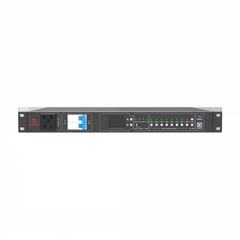
In the operation of professional sound systems, acoustic feedback is a common and highly destructive problem. It manifests as a harsh howling or squealing sound, which not only severely impacts the listening experience but can also damage expensive speaker drivers. The root cause of this phenomenon lies in the formation of a closed acoustic loop between the speaker (output) and the microphone (input): the microphone picks up the sound emitted by the speaker, the signal is amplified by the system and emitted again from the speaker, only to be picked up once more by the microphone... This cycle repeats, causing the signal to be continuously amplified and superimposed at specific resonant frequencies. Eventually, the system enters an unstable state, producing the uncomfortable howl.
To effectively solve this persistent issue, modern digital audio processors commonly integrate advanced Feedback Elimination/Suppression functionality. Its core objective is to accurately identify and eliminate the signal energy within the feedback path, ensuring system stability and improving speech intelligibility and music fidelity. Its working principle primarily involves the following key steps:
Core Principles of Feedback Elimination
- Feedback Path Modeling (System Identification):
The first step for a feedback eliminator is to identify and model the complete acoustic feedback path from the speaker to the microphone. This path includes the speaker response, the room's acoustic characteristics (such as reverberation and standing waves), the microphone characteristics, and their relative positions.
Modern digital processors typically employ adaptive algorithms. By injecting specific test signals (like pink noise or sine sweeps) into the system or utilizing the actual program signal itself, they analyze the correlation between the input (microphone) and output (speaker reference signal) in real-time, dynamically constructing an accurate model of the feedback path. This model is essentially a digital filter that simulates the characteristics of the real acoustic feedback.
- Adaptive Filtering and Reference Signal:
Based on the established feedback path model, the processor internally generates an Adaptive Filter. The core task of this filter is prediction: it predicts what signal would be produced at the microphone input if the current reference signal (i.e., the ideal signal sent to the speakers, processed but *before* feedback is added) were to pass through the actual acoustic feedback path.
The adaptive filter continuously compares its prediction (the predicted feedback signal) with the actual microphone input signal. The difference between them (called the error signal) drives the real-time, dynamic adjustment of the filter's parameters. The goal is to make the predicted feedback signal infinitely approximate the actual feedback component contained within the microphone signal. This process requires extremely high computational speed and precision.
- Precise Cancellation of the Feedback Signal:
Once the adaptive filter can accurately simulate the feedback component in the microphone signal, the processor generates a cancellation signal that is equal in amplitude but opposite in phase (180 degrees out of phase).
This inverted signal is superimposed in real-time onto the original microphone input signal. Through precise phase inversion and amplitude matching, the feedback signal component is effectively canceled or significantly suppressed at the source (before the input signal enters the processor's processing chain). Ultimately, the processor primarily handles the desired clean source signal (voice, instruments, etc.), greatly reducing the energy that causes howling.
- Dynamic Tracking and Real-time Adaptation:
The acoustic environment is dynamic. For example, people moving, doors or windows opening/closing, objects being moved, and even changes in temperature and humidity can cause the feedback path from speaker to microphone to change.
Therefore, the feedback eliminator must be highly real-time and adaptive. It needs to continuously monitor the error signal and dynamically update the adaptive filter's parameters accordingly. This ensures the model always keeps pace with changes in the current acoustic environment, maintaining optimal feedback suppression. This "learning" and "adjustment" process never stops during system operation.
Widespread Applications of Feedback Elimination Technology
Thanks to its crucial role in stabilizing systems and improving sound quality, feedback elimination technology is widely used in various scenarios requiring high-gain sound reinforcement:
- Live Performance: In concerts, theaters, and variety stages, where there are numerous microphones, high gain requirements, and complex, changing acoustic environments, feedback elimination is a key technical barrier ensuring smooth performances and preventing disruptive sudden howls that interfere with the artistic presentation.
- Conferencing & Lecture Halls: In meeting rooms, auditoriums, and classrooms, clear and intelligible speech transmission is paramount. Feedback elimination allows the system to operate safely at higher gains, significantly improving speech intelligibility and Gain Before Feedback (GBF), ensuring every listener can hear the speaker clearly.
- Broadcasting & Recording: In professional audio production environments like radio studios, TV studios, and music recording studios, any minor noise or howl is unacceptable. Feedback elimination technology helps maintain pure recording and broadcast signal quality, avoiding unwanted interference and elevating the professional standard of the work.
- Installed & Portable PA Systems: This includes fixed installation venues like churches, auditoriums, and hotel ballrooms, as well as scenarios like KTV rooms, tour guide commentary systems, and portable speech systems. In these applications, feedback elimination technology greatly simplifies system setup, enhances ease of use and the end-user's auditory experience, ensuring sound is clear, stable, and free from howling.
Summary
The feedback elimination function within digital audio processors, utilizing sophisticated algorithms to model the acoustic feedback path in real-time and employing adaptive filtering to generate inverse signals for precise cancellation, is the core technology for solving howling issues in sound systems and ensuring system stability and sound purity. It plays an indispensable role in live performances, conferences, lectures, broadcasting, recording, and various sound reinforcement scenarios. It is an essential "safeguard" and "quality assurance" component of modern professional audio systems.
Product recommendation
https://www.tendzone.net/audio-processor/web-based-audio-processors/ai-audio-processor.html
https://www.tendzone.net/audio-processor/fixed-audio-processors/dante-dsp.html


