


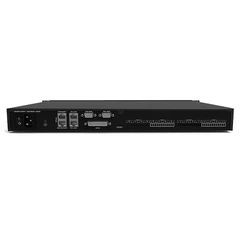



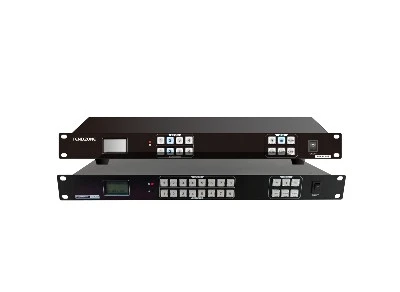


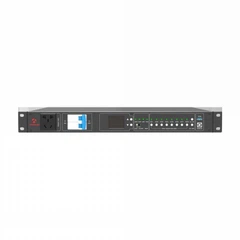
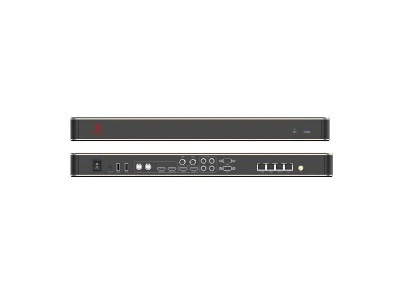

Shenzhen Tendzone Intelligent Technology Co., Ltd. is one of the most reliable manufacturers and suppliers of 9 cards modular video wall controller in China. Please feel free to wholesale high quality 9 cards modular video wall controller made in China here from our factory. We also accept customized orders.
VMH Series Modular Video Processor
The VMH series takes any mix of HDMI, DisplayPort, DVI, VGA, SDI, CVBS and IP video sources and places them on LCD or LED video walls in freely arranged windows. A chassis is bought once and expanded by adding cards, so a 2U unit specified for a meeting room and a 12U unit driving a control-room wall run the same card set, the same firmware and the same control software.
Hot-swappable cards | 4096×2160 @60 Hz input | 8 windows per display | 128 scene presets | LCD and LED splicing | RS-232, LAN and web control

Product Overview
The VMH series is a family of modular multi-window video processors built on a pure hardware FPGA architecture. There is no embedded operating system, so the processor starts instantly, does not degrade over time and cannot be affected by the malware and driver issues that affect PC-based wall controllers.
Each chassis carries a fixed number of input and output card slots around a common backplane. Any source can be shown on any screen, over the whole wall or inside a window; windows can be overlaid, moved, scaled, stretched or cropped, and a single display can carry up to eight windows with layers distributed dynamically. Switching between sources is seamless, with no black frame, freeze or tearing.
|
5 |
76 × 76 |
4K60 |
8 |
468 Gbps |
|
Chassis, 2U to 12U |
Maximum inputs and outputs |
Maximum input on HDMI 2.0 / DP 1.2 |
Windows per display |
Backplane bandwidth |

One platform in five capacities. The chassis differ in rack height, slot count, weight and power consumption; the card set, firmware and control software do not change.

Key features and benefits
The feature set is common to all five chassis.
Hardware FPGA, no operating system
Signal handling runs entirely in FPGA logic. There is no boot sequence, no driver stack and no update that can fail at the wrong moment, and the timing is held by hardware rather than by a general-purpose CPU.

Seamless switching on every crosspoint
Any input can be sent to any output in any combination. The change is made inside the frame, so there is no black screen, stutter, freeze or tearing when a presenter changes source or an operator calls a new layout.

Up to eight windows on one screen
Windows can be opened, overlaid, roamed, scaled, stretched and cropped on any output, with layers allocated dynamically between the four ports of an output card. Preset window patterns can be called with a single command, so the correct layout arrives before the source does.
Mixed 2K and 4K cards in one chassis
4K and 2K input and output cards share the same slots and can be combined freely. A room can start with 1080p sources and add 4K60 capacity later without replacing the chassis, and 4K inputs can be paired with the four-layer or eight-layer output cards where a full 4K60 path is needed.

Eleven input cards, one slot standard
HDMI 2.0 and DisplayPort 1.2 at 4K60, HDMI and DVI at 4K30, four-port HDMI, DVI, VGA, 3G-SDI and CVBS cards, audio-embedded variants, and an IP decode card for H.264 and H.265 streams - all electrically identical to the backplane, all hot-swappable.

One processor for LCD and LED walls
Outputs can be spliced across LCD panels or mapped point to point onto an LED wall, up to 4096 pixels wide and 3840 pixels high. Seam compensation is adjustable to one pixel, and output ports can be re-mapped to sending cards in software rather than by re-cabling.

Audio follows the picture
Embedded audio is carried with the HDMI and DVI sources, external audio can be embedded on the input card, and a four-channel balanced output card feeds amplifiers and DSPs. Outputs can be bound to screen groups, muted individually or switched together with the video, with no pops on power-up or switching.

Built for unattended rooms
Cards are hot-swappable, the configuration survives power loss, scenes and groups can be backed up and restored, fan speed is selectable at three levels, and both the host and every card can be upgraded in the field over the network.

Application Scenarios
Specified wherever several sources have to be visible at the same time on several screens, and where the person running the room is not an AV technician.
|
|
Security and surveillance monitoring Camera streams arrive on the IP decode card and analogue or HD-SDI recorders on the SDI and CVBS cards, then appear on a video wall in 1, 4, 9, 16 or 36-window layouts. Operators call a different camera group for each incident without disturbing the other screens. |
|
|
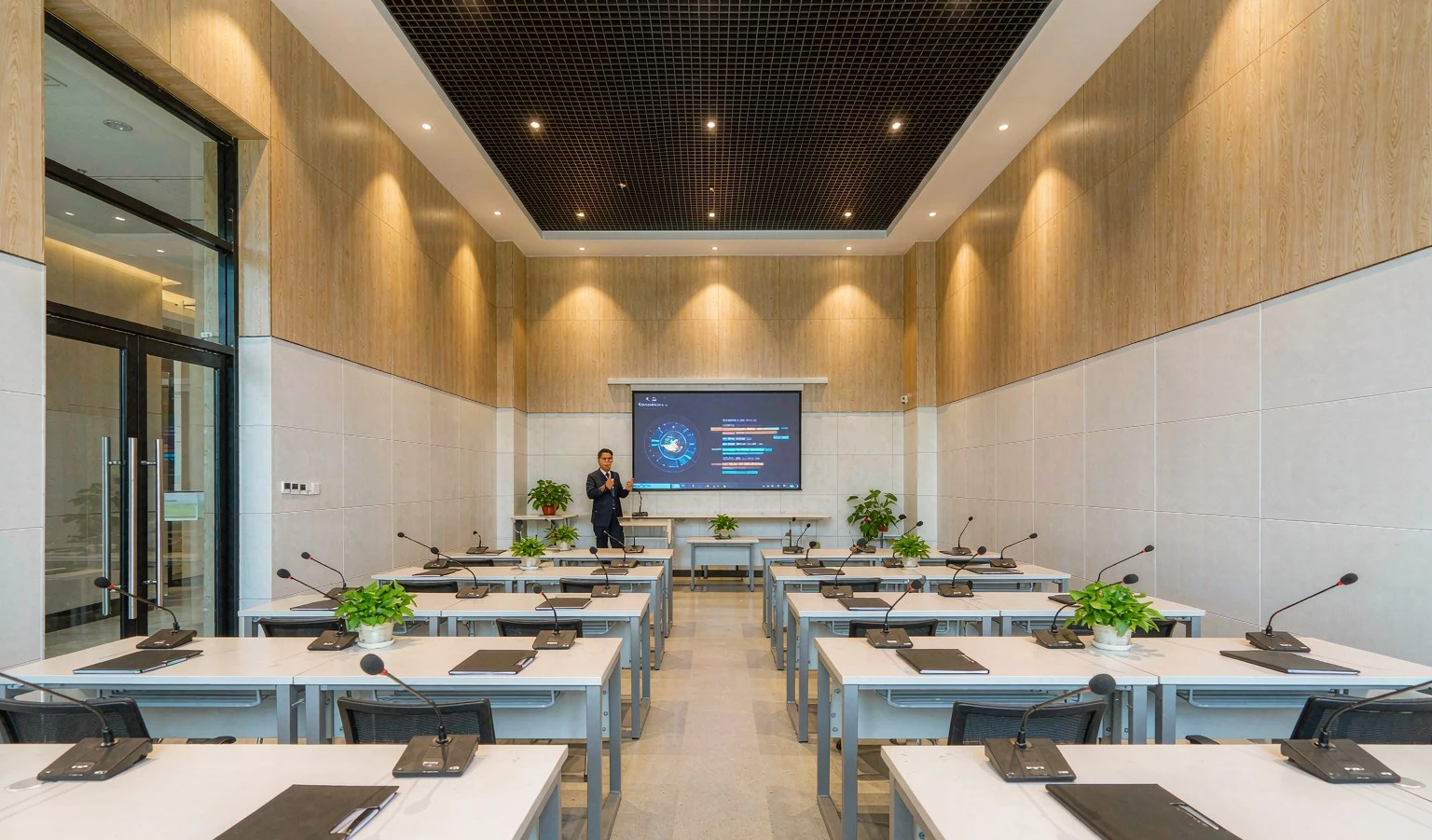
Conference and training rooms Presentation PCs, laptops, a video codec and a document camera share two displays. Preset window patterns put the presenter and the shared content side by side, and the audio output card feeds the room amplifier from the same chassis. |
|
|
Lecture halls and auditoriums A lectern PC, document camera and media player drive the main screen and the confidence monitors at different resolutions. One scene recall moves the hall from lecture to panel discussion, including which sources go to the overflow screens. |


Exhibition, retail and show venues
LED walls are driven point to point with seam compensation set to the pixel, and players or media servers are switched by scene rather than by cable. Output ports can be re-mapped to sending cards in software when the wall layout changes.
Other typical installations
- Government briefing rooms - several departments presenting to one wall from their own sources
- Education and research - lecture capture, simulation review and multi-source teaching
- Information publishing - scheduled content across lobby and corridor screens
- Advertising and media - player-to-wall routing changed without touching the cabling
- Retail and showrooms - product video and live demo on the same display wall
- Stage and entertainment - backdrop LED, side screens and confidence feeds from one processor
Where it sits in the system
Sources connect to the input cards, displays and audio zones to the output cards, and the processor is controlled locally, over the network or from the room control system.


- Cable length. Input cable runs are supported up to 15 m. Output cards carry compensation gain, which extends output runs to 25 m.
- Layer budget. A 4K30 input consumes two layers of an output card and a 4K60 input four, so the number of simultaneous 4K windows on one card depends on the input resolution and on the card fitted.
- Output groups. Up to four independent output groups can be defined, each with its own resolution, so a single chassis can drive a 2×2 LCD wall, an LED wall and two 1080p repeaters at the same time.
- Bandwidth. The backplane provides at least 468 Gbps of signal processing capacity, which is shared across all slots.
Chassis comparison
Input resolution is the same on all five chassis: up to 4096×2160 @60 Hz, 3840×2160 @60 Hz and 2160×3840 @60 Hz (portrait). Output resolution is up to 4096×2160 @30 Hz throughout. Power figures are quoted as published in the product data sheet: no-load consumption is stated where available, otherwise the operating figure is given. Weights exclude cards unless stated. All chassis accept 100–240 V AC, 50/60 Hz.
|
Item |
VMH-0203D |
VMH-0306D |
VMH-0504D |
VMH-0909D |
VMH-1919D |
|
Rack height |
2U |
3U |
3U |
6U |
12U |
|
Input card slots |
2 |
3 |
5 |
9 |
19 |
|
Output card slots |
3 |
6 |
4 |
9 |
19 |
|
Maximum input ports |
8 |
12 |
20 |
36 |
76 |
|
Maximum output ports |
12 |
24 |
16 |
36 |
76 |
|
Dimensions W×H×D |
437×88×320 mm |
437×136×320 mm |
436.6×136×320 mm |
436.6×269×320 mm |
436.6×534×320 mm |
|
Net weight |
5.8 kg, without cards |
6.5 kg without cards, 9.2 kg fully loaded |
6.7 kg, without cards |
11.27 kg |
15.55 kg |
|
Power consumption |
6.6 W no-load |
9.3 W no-load, 88.5 W fully loaded |
7.1 W no-load |
25 W |
70 W |
|
Power supply |
Single, dual optional |
Single, dual optional |
Single, dual optional |
Dual, standard |
Dual, standard |
|
Windows per display |
8 |
8 |
8 |
8 |
8 |
About Tendzone
Established in 2010, Tendzone is a global leader in providing advanced audio-visual (AV) solutions and manufacturing high-quality AV products. We specialize in a wide range of cutting-edge technologies, including audio processors, microphones, speakers, power amplifiers, AV over IP systems, digital conference systems, and MIDIS Distributed Multimedia Transmission Control Systems. Our solutions are trusted across industries such as conference rooms, command centers, education, multi-functional halls, and stadiums.
Our Service
Our dedicated customer support team offers reliable technical support, quick response times, and preventive maintenance service.

Pre-Sales
We assess your unique requirements, provide tailored consultations and demonstrations, and design a customized AV system to ensure the perfect solution.

In-Sales
We deliver transparent proposals, manage the full project implementation, and provide initial training to ensure a smooth and successful setup.

After-Sales
We offer prompt technical support, customized maintenance plans, continuous software upgrades, and actively use your feedback to drive ongoing service improvement.
Tendzone, established in 2010, is a global leader in providing advanced audio-visual (AV) solutions and manufacturing high-quality AV products. We specialize in a wide range of cutting-edge technologies, including audio processors, microphones, speakers, power amplifiers, AV over IP systems, digital conference systems, and MIDIS Distributed Multimedia Transmission Control Systems. Our solutions are trusted across industries such as conference rooms, command centers, education, multi-functional halls, and stadiums.
Our address
Building 1A, Building 16, Shenzhen International Innovation Valley, Dashi 1st Road, Nanshan District, Shenzhen
Phone Number
Mobile/Wechat/WhatsApp : (+86) 13302998794
travis.tu@tendzone.com

Hot Tags: 9 cards modular video wall controller, China 9 cards modular video wall controller manufacturers, suppliers, factory
Technical specifications
Specifications common to the series are listed first; values that differ between chassis or between cards are given in the tables above and in the card sections.
- Processing and switching
|
Item |
Specification |
|
Architecture |
Pure hardware FPGA, modular plug-in cards, no embedded operating system |
|
Backplane bandwidth |
≥ 468 Gbps |
|
Switching |
Seamless crosspoint switching; no black frame, freeze, judder or tearing |
|
Windowing |
Arbitrary window, overlay, roam, scale, stretch and crop; up to 8 windows per display; dynamic layer allocation |
|
Output groups |
Up to 4 groups, each with an independent output resolution |
|
Scene presets |
128 scenes, save and recall; 5 independent audio scenes on VMH-0909D and VMH-1919D |
|
Cropping |
Up to 4 crop presets stored per input source |
|
OSD |
Custom character overlay per input source: font, size, colour, opacity and position |
|
Preset layouts |
Pre-defined window patterns, recalled in one command |
|
LCD splicing |
Seam compensation adjustable to 1 pixel; point-to-point LED mapping; software mapping of output ports to LED sending cards |
|
Brightness |
Per output group, 0–100%, default 50% |
|
Cooling |
Fan speed selectable at low, medium or high |
|
Cable length |
Input up to 15 m; output up to 25 m with compensation gain |
|
EDID |
Embedded EDID management with DDC control; EDID write support |
|
Monitoring |
Input and output connection detection with live system status |
- Control, power and installation
|
Item |
Specification |
|
Local control |
RS-232 (DB9) with loop-out; quick central-control commands for windowing and roaming |
|
Network control |
TCP/IP; LAN client–server software for Windows; built-in web interface (advanced control card) |
|
Concurrent users |
Client software: 3 users. Web interface: up to 64 users on VMH-0203D, VMH-0306D and VMH-0504D |
|
Mobile control |
Android app control on VMH-0909D and VMH-1919D |
|
Room control |
RS-485, RS-232, IR in / out and 2 × IO via the VMH-IO-FD environmental card |
|
Software functions |
Signal switching, preview, splicing set-up, scene save and recall, scene polling, resolution set-up, card detection, backup and restore, factory reset, online upgrade |
|
User management |
Tiered users and permissions; optional time-limited authorisation for rental use |
|
Clock |
Hardware clock with time synchronisation |
|
Power input |
100–240 V AC, 50/60 Hz |
|
Power supply |
Single supply as standard with dual supply option on 2U and 3U chassis; dual supply as standard on 6U and 12U chassis |
|
Mounting |
Rack-mount chassis with front rack ears; 437 mm panel width |
|
Card handling |
Input and output cards hot-swappable |
|
Configuration memory |
Power-loss memory; configuration, group, resolution and network settings exportable and restorable |


