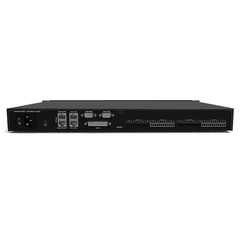





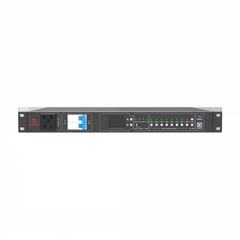


Shenzhen Tendzone Intelligent Technology Co., Ltd. is one of the most reliable manufacturers and suppliers of hyperconverged cloud node(thirteen-in-one) in China. Please feel free to wholesale high quality hyperconverged cloud node(thirteen-in-one) made in China here from our factory. We also accept customized orders.
Hyperconverged cloud node(Thirteen-in-one)
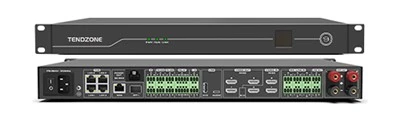
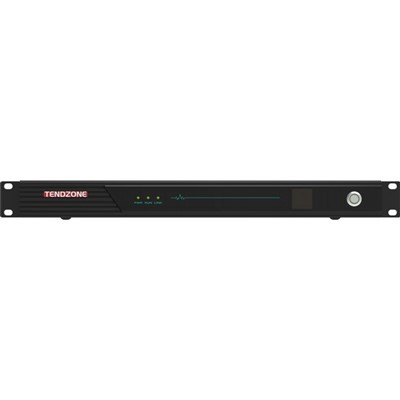
CLIMBER-2009 is Tendzone's newly released 13-in-1 multi-functional terminal host, built on years of converged-product R&D experience. It integrates the company's latest audio algorithms, video codec, centralized control, media processing and remote communication technologies, and runs on a domestic core processor with a new-generation embedded system optimized for AV convergence.
The product adopts a fully plug-in-card design composed of a chassis plus functional boards, allowing flexible configuration for different scenarios. It integrates remote video conferencing, local recording, audio reinforcement, video matrix switching, environmental control, unified touch control, distributed system input/output codec, IPC access and a PoE gigabit switch - serving multimedia meeting rooms, smart classrooms, lecture halls, multi-function halls and mobile command & dispatch.

The host can network independently, and offers optional OPS computer card, wireless casting card, wireless microphone card and video input/output cards, making it easy to connect all kinds of AV peripherals while saving equipment space and providing intelligent user interfaces. It is widely applied in government and enterprises, public security / procuratorate / court, finance, transportation, armed police, education and healthcare.
|
13-in-1 |
8×1080P |
4K30 |
16 |
7×24 |
|
Functions Integrated |
Max Codec Channels |
H.265 Encode / Decode |
IP Camera Channels |
Continuous Operation |

13-in-1All-in-One Integration

|
Video Conferencing H.323 / SIP point-to-point calls with content sharing; up to 6-party meetings (SIP). |
Local Recording 6-channel simultaneous recording and 1× 4K multi-picture composite recording (MP4). |
|
Live Streaming & On-Demand Up to 10 channels of multicast, live streaming and on-demand distribution. |
Audio Reinforcement & DSP AEC / AGC / ANC / AFC, mixing matrix, 4×200W@8Ω digital amplifier outputs. |
|
Video Matrix Switching 8×4K HDMI inputs and 8×4K HDMI outputs with audio-follow switching. |
Distributed AV Codec MIDIS distributed input/output codec node for distributed AV systems. |
|
IPC Access 16 local network camera channels plus 8 network AV forwarding channels. |
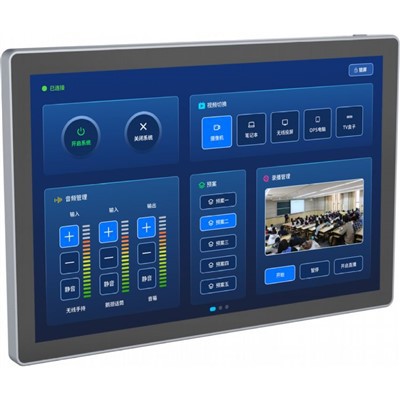
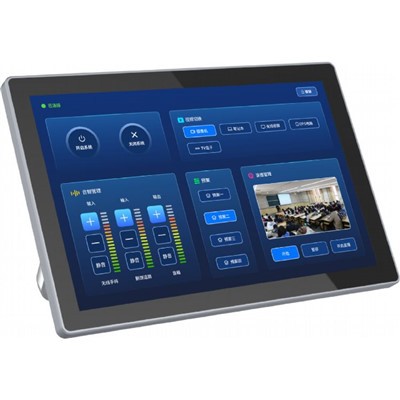
Central Control One-touch control of system power, volume, sources, cameras, recording and environment. |
|
Environmental Control 3×RS-232/485, 2×RELAY (12V out), 2×I/O, 2×IR for lights, curtains and devices. |
PoE Gigabit Switching 2 WAN + 6 LAN gigabit ports, 4 of them with PoE power output. |
|
OPS Computer Integrated OPS slot with Windows or domestic Kylin platform options. |
Wireless Casting One-key dongle casting plus client casting for PC / phone / pad. |
|
Wireless Microphones UHF module supporting 2 simultaneous handheld / lavalier / headset mics. |
Hyperconverged cloud node application scenarios
The Hyperconverged Cloud Node is suitable for use in multimedia meeting rooms, smart classrooms, lecture halls, mobile command vehicles, and other scenarios.


KeyFeatures
|
High Definition, Multi-Channel Up to 8 channels of 1080P encoding and 8 channels of decoding, with abundant interfaces that connect to peripheral devices from different vendors. Multiple scenarios are supported - local meetings, remote meetings, command dispatch, remote training, remote supervision and surgical teaching - with local/remote centralized control and local recording & live streaming. |
Smart Control One-touch operation on the control panel improves users' IT application capability. The digital audio processor's algorithm-flow-based UI greatly simplifies commissioning of local sound reinforcement and remote interactive audio. Switch, mix and play at will; push content to the cloud resource management platform for internet live streaming. Supports remote interactive calls and multi-host multi-party interaction for remote collaboration. |
|
Stable & Reliable Embedded Linux system - virus-free by architecture. The telecom-grade structural design keeps the host stable and reliable for 7×24 continuous operation, ideal for mission-critical meeting and command environments. |
Device Form 3U rack-mount chassis with an approximately 3-inch LCD display window on the front panel. Supports standby and sleep/wake states, with dual power switches - one hardware switch and one software switch working together for safe, flexible power management. |

OEM customization

Our Hyperconverged Cloud Node is customizable - appearance, dimensions, functions, materials, logo, and more can all be tailored to customer needs.

Quality Certified & Strictly Tested Products
The product has passed CCC certification, FCC certification, CE certification, RoHS certification, vehicle vibration test report, certification report from the Ministry of Public Security, etc.
ModularCard System
The chassis ships with the MAIN card and AUDIO card; all other function cards are optional and factory-installed to order.
- CR-4I-HDMI4-Channel HDMI Input Card
One card providing four HDMI inputs with embedded audio. Maximum 2 HDMI input cards per host; HDMI and SDI input cards can be mixed.

- CR-4I-SD4-Channel SDI Input Card
One card providing four SDI inputs for broadcast-grade sources. Maximum 2 SDI input cards per host.

- CR-4O-HDMI4-Channel HDMI Output Card
One card providing four HDMI outputs with embedded audio. Maximum 2 HDMI output cards per host; output formats are configurable.

- CR-OPS-WINOPS Computer Card (Windows)
Integrated OPS card with 11th-generation Intel platform, pre-installed with Windows 11 Pro. Maximum 1 OPS card per host.

- CR-OPS-KYDomestic OPS Computer Card (Kylin)
Fully domestic platform: Phytium D2000 8-core processor with Galaxy Kylin operating system (genuine license pre-installed). Maximum 1 OPS card per host.

- CR-VIA-CASTWireless Casting Card & Dongle
Wireless casting receiver card with one VIA-T8 one-key casting dongle included; two short antennas, two antenna extension cables and two suction cups are provided to prevent signal shielding inside racks. Maximum 1 card per host.

- CR-MD-MICUHF Wireless Microphone Card & Handheld Mics
UHF wireless speech reception card with two MD-13 handheld microphones included; antennas and extension kits provided. Maximum 1 card per host.

FAQ
Q1: What are the specific "13-in-1" functions of the CLIMBER-2009?
The CLIMBER-2009 integrates the following 13 types of functions into a single device:
Remote video conferencing
Local recording and broadcasting
Audio reinforcement
Video matrix switching
Peripheral environmental control
Centralized touch control
Distributed system input/output encoding/decoding
IPC network camera access
PoE Gigabit switch
Digital audio processor
Central control
OPS computer (optional)
Wireless screen projection and wireless microphone (optional)
One device can meet the needs of multimedia conference rooms, smart classrooms, command and dispatch centers, and other scenarios.
Q2: What audio input/output interfaces does the device have? Does it support phantom power and digital power amplification?
Audio Inputs:
8 Phoenix terminal inputs (support 48V phantom-powered MIC or line input)
8 HDMI embedded audio inputs
16 RTSP audio inputs
2 DSP audio inputs
1 OPS audio input, 1 wireless screen projection audio input, 1 wireless microphone module audio input
2 hand-in-hand digital microphone links (via DIGIT MIC network port)
Audio Outputs:
4 line outputs
4 channels of digital power amplifier output (4 × 200W @ 8Ω)
8 HDMI embedded audio outputs
10 DSP outputs, 1 OPS output
Audio Processing: Supports AEC, AGC, ANC/ANS, AFC, mixing matrix, packet loss compensation (PLC).
Q3: Does the device support remote video conferencing? What is the maximum number of participants?
Yes.
Protocols: H.323 and SIP, with dual-stream support (BFCP/H.239).
Maximum 6-party conference per single node (over SIP protocol). Supports meeting templates, scheduled meetings, adding/removing terminals, one-click mute/unmute all participants.
Supports GK registration, SIP registration, and short-number dialing.
End-to-end encryption for audio and video (point-to-point and multi-party) to prevent eavesdropping.
Hot Tags: hyperconverged cloud node(thirteen-in-one), China hyperconverged cloud node(thirteen-in-one) manufacturers, suppliers, factory
Technical Specifications
|
Item |
Specification |
|
Security & Stability |
Industrial-grade system architecture based on an embedded system, virus-free |
|
Data Interfaces |
2× USB Type-A, 1× USB Type-B |
|
Network Cameras |
16 local IPC access channels; 8 network AV forwarding channels |
|
Video Codec |
Up to 2×4K30 encoding + 2×4K30 decoding, or 4×1080P60, or 8×1080P@30; decode up to 8×1080P@30 |
|
AV Protocols |
Audio: G.711, G.722, G.722.1, G.722.1C, AAC; 8 independent audio encode streams with independent audio recording. Video: H.264 HP/MP/BP and H.265 HP/MP/BP |
|
Display Terminal |
Built-in video splitting: single, PIP, POP and up to 16-split composition; up to 4 groups of independent multi-picture composites; 2K/4K output |
|
Control Panels |
Optional 10.1" wired Android touch panel; 10.1" PoE desktop touch panel; 10.1" PoE in-wall touch panel (wall box included); 4" PoE 86-box touch panel |
|
Codec Bitrate |
Up to 4×4K30, or 8×1080P60, or 16×1080P30 codec; per-channel 128kbps / 256kbps / 384kbps / 512kbps / 768kbps / 1M / 1.5M / 2M / 3M / 4M / 6M / 8Mbps |
|
Audio Input |
8× Phoenix-terminal inputs (48V phantom MIC or line-in), 8× HDMI embedded audio, 16× RTSP audio, 2× DSP, 1× OPS, 1× wireless casting, 1× wireless mic module; DIGIT MIC daisy-chain digital speech system - 2 chains, max 15 mics per chain / 30 in dual-chain, 3 mics speaking simultaneously (6 in dual-chain) |
|
Audio Output |
4× line out, 4×200W@8Ω digital amplifier outputs, 8× HDMI embedded audio, 10× DSP, 1× OPS; volume control; sync and mixing modes |
|
Video Input |
8× 4K HDMI inputs (optional SDI input cards; HDMI and SDI cards mixable; max 2 video input cards per chassis), 16× IP camera inputs, 1× internal OPS, 1× internal wireless casting |
|
Video Output |
8× 4K HDMI outputs, 8× RTMP push streams, 1× internal OPS output; HDMI output audio-follow switching |
|
Audio Processing |
AEC (echo cancellation), AGC (gain control), ANC/ANS (noise suppression), AFC (feedback cancellation), mixing matrix (AM), PLC (packet-loss concealment) |
|
Video Processing |
Resolution adaptation, switching, distribution, picture splitting, subtitle overlay, image parameter adjustment |
|
Communication Protocols |
SIP, BFCP, H.323, H.239, E.164, H.245, NAT, H.225, Q.931, RTSP, RTMP, TCP/IP, HTTP, FTP, TCP, UDP, NTP, RTP, RTCP, Telnet, TLS |
|
Network Interfaces |
2× WAN + 6× LAN (or 8 ports all-through); 4 ports with PoE power; 10/100/1000Mbps adaptive RJ45 |
|
Audio Mixing |
Local audio, HDMI embedded audio, RTSP remote streams, OPS, wireless casting and wireless mic module audio into the mixer with dynamic selection |
|
Central Control |
One-touch control: system on/off, output volume, source switching, camera control, recording control, remote call, environmental control |
|
Control Interfaces |
3× RS-232/485, 1× RS232/RS485 DEBUG, 2× RELAY (12V external supply), 2× I/O, 2× IR |
|
Video Conferencing |
H.323 / SIP point-to-point calls with content sharing; up to 6-party meetings (SIP); meeting templates, scheduled meetings, invite/remove participants, individual or one-key mute; GK / SIP registration with short-number calling; encrypted point-to-point and multi-party AV transmission |
|
Live Streaming |
Up to 10 channels of multicast, live streaming and on-demand |
|
Recording |
Recording distributor and client; 6-channel simultaneous recording; 1× 4K multi-picture composite recording (MP4; 4K HDMI/IPC sources not supported for composite); USB auto/manual copy, USB system restore, USB disc burning; recording file management (download / export / edit / delete) |
|
Storage |
Standard 2TB 3.5" surveillance-grade HDD, up to 16TB (single bay); dual-bay option with two surveillance HDDs; USB storage expansion |
|
Energy Saving |
Network standby and wake; one-touch system power |
|
Maintenance |
Web management: port configuration, password / IP change, factory reset, software upgrade, indicator control, IR learning, log management, serial and Telnet debugging, remote O&M |
|
Built-in OPS Computer |
Integrated OPS computer with 16G RAM and 512G SSD |
|
Wireless Casting |
One-key dongle casting; PC / phone / pad client casting; external antenna to extend reception |
|
Wireless Microphones |
2 simultaneous wireless mics; handheld / lavalier / headset transmitters; external antenna support |
|
Mounting |
3U telecom-standard rack installation |
|
Dimensions (W×D×H) |
437×442×132.5mm (with handles); 437×410×132.5mm (without handles) |
|
Power Supply |
AC100~240V, 50/60Hz |
|
Power Consumption |
50W typical; 750W full load |
|
Weight |
14.6kg net; 16kg gross |
|
Operating Temperature |
0~45℃ |
|
Humidity / Altitude |
10%~90% RH; altitude below 5000m |
|
Standard Configuration |
Chassis with MAIN card and AUDIO card pre-installed; other cards optional |
|
MAIN Card |
8× gigabit ports (4× PoE), 3× RS-232/485, 1× RS232/RS485 DEBUG, 2× RELAY, 2× I/O, 2× IR, 2× USB Type-A, 1× USB Type-B |
|
AUDIO Card |
DIGIT MIC daisy-chain digital speech interface (2 chains; mic models compatible with AMH-800N series), 8× Phoenix mic/line inputs (48V phantom supported), 4× Phoenix line outputs, 4× digital amplifier outputs (4×200W@8Ω) |